

Every diesel engine teardown reaches the same decision point — what do you do with the crankshaft? It is one of the most expensive components in the engine and one of the most consequential to get wrong. The answer is never obvious from a visual check alone. Grinding, polishing, and replacement each have specific conditions that justify them, and confusing one for another costs time, money, and engine reliability. This post covers how to evaluate a diesel crankshaft properly, what the inspection findings actually mean, and how to make the right call before the engine goes back together.
Why Crankshaft Condition Determines Rebuild Outcome
What the Crankshaft Does Under Load
The crankshaft converts the linear force of each piston stroke into rotational output. Every power stroke loads the journals with thousands of pounds of force, sustained across millions of cycles over the life of the engine. That continuous loading creates wear, heat, and surface fatigue on the journal surfaces where bearings ride. The condition of those surfaces at rebuild time determines how long the rebuilt engine will last.
How Journal Condition Affects Bearing Life and Oil Pressure
Bearings depend on a consistent oil film to prevent metal-to-metal contact. When journal surfaces are scored, worn out of round, or tapered, that film breaks down. The result is accelerated bearing wear, reduced oil pressure, and thermal damage that spreads through the engine. A rebuild that installs new bearings on worn journals will fail faster than the original engine did.
Why Visual Inspection Is Never Enough
A crankshaft can look acceptable and still be unserviceable. Scoring that appears minor can measure outside tolerance. Journals that look round are often out of round by amounts that matter to bearing clearance. Cracks in the fillet radius are invisible to the naked eye until they propagate into a fracture. Every crankshaft that goes into a diesel rebuild deserves measurement and crack detection, not just a wipe-down and a look.
How to Evaluate a Diesel Crankshaft Before Making Any Call
Cleaning and Initial Inspection
The shaft must be thoroughly cleaned before any evaluation begins. Oil, carbon, and debris on the journal surfaces prevent accurate measurement and hide damage. Once clean, the journals are examined for visible scoring, discoloration from heat, corrosion pitting, and any signs of bearing seizure. This initial pass identifies obvious problems but does not replace measurement.
Journal Measurement — What the Numbers Mean
Each journal is measured at multiple points and orientations to determine:
- Diameter compared to OEM specification
- Out-of-round condition across the journal face
- Taper from one end of the journal to the other
- Surface finish condition
These measurements determine whether the journal is within the range where polishing is sufficient, within a grindable undersize range, or beyond recoverable limits where replacement is the only path.
Magnaflux Crack Detection Before Any Machining
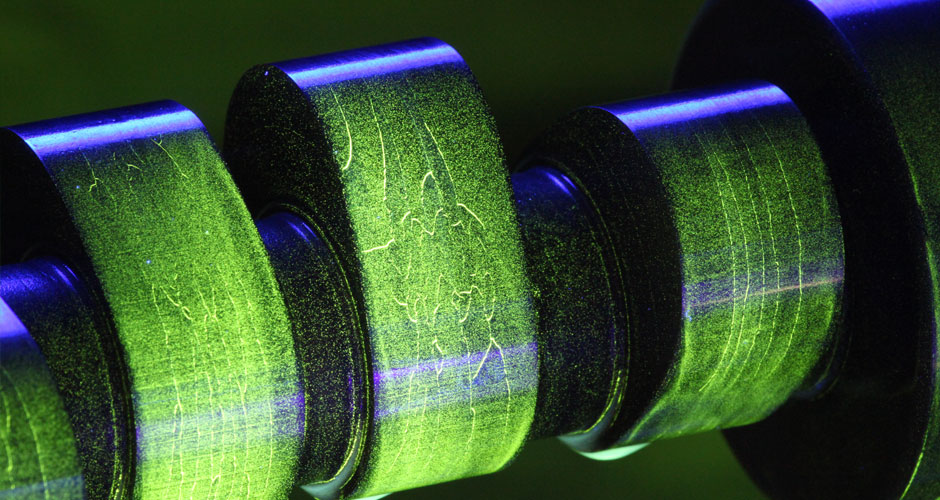
Crack detection must happen before any machining work begins. Magnaflux inspection uses magnetic particle testing to reveal subsurface cracks that measurement alone cannot find. Cracks in the fillet radius — the curved transition between the journal and the crank web — are particularly dangerous. A journal that measures within grindable range but carries a fillet crack is not a grinding candidate. It is scrap. Spending machine time on a cracked shaft wastes money and puts the rebuild at risk.
For a full explanation of how magnaflux testing works and why it must happen before any machining decision, read our guide on magnaflux crack detection for diesel engine components.
When Crankshaft Polishing Is the Right Call
What Polishing Actually Does
Polishing removes minor surface imperfections, light scoring, and rough texture from journal surfaces without changing the journal diameter. It improves surface finish to support proper bearing contact and oil film formation. Polishing is a precision finishing step, not a corrective machining process.
The Conditions That Justify Polishing
Polishing is appropriate when:
- Journal diameter is within OEM specification
- Out-of-round and taper measurements are within acceptable limits
- Surface condition shows light scoring or roughness without deep material loss
- No cracks are detected during magnaflux inspection
In these cases, polishing restores the surface finish needed for reliable bearing operation without removing material that would require undersize bearings.
What Polishing Cannot Fix
Polishing does not correct out-of-round journals, taper, or undersize diameter. It does not address deep scoring or material loss. Attempting to polish a journal that requires grinding produces a shaft that looks better but still fails to hold bearing clearance. The choice between polishing and grinding is a measurement call, not a judgment based on appearance.
When Crankshaft Grinding Is Required
What Grinding Restores and How It Works
Crankshaft grinding removes material from the journal surface to restore correct geometry — round, straight, and within a defined undersize diameter. The shaft is mounted on a precision grinding machine that rotates it while an abrasive wheel removes material to the target dimension. After grinding, the journals are polished to achieve the correct surface finish for bearing contact.
Journal Wear Thresholds That Require Grinding
Grinding is necessary when measurement reveals:
- Out-of-round condition beyond the manufacturer’s service limit
- Taper that exceeds the allowable tolerance across the journal length
- Deep scoring with material loss that polishing cannot address
- Journal diameter below specification but still within the first or subsequent undersize range
Each grind reduces the journal to a standardized undersize — typically 0.010, 0.020, or 0.030 inches below standard — which corresponds to available undersize bearing sets.
Undersize Bearings and What They Mean for the Rebuild
Undersize bearings are manufactured to match ground journals. When a crankshaft is ground to the first undersize, the corresponding bearing set restores correct oil clearance for that dimension. The availability of undersize bearings for the specific engine application must be confirmed before grinding begins. For older or specialized diesel platforms, bearing availability can limit whether grinding is a practical option.
When Replacement Is the Only Correct Answer
Not every crankshaft is a repair candidate. Replacement is the correct path when:
- Cracks are detected in the fillet radius during magnaflux inspection
- Journal wear has exceeded the last available undersize dimension
- The shaft shows signs of twisting or bending that affect bearing alignment
- Thermal damage has altered the hardness of the journal surface
- Multiple journals require grinding beyond what the remaining material supports
Each of these conditions produces a shaft that cannot be restored to reliable service through any machining process. The cost of grinding a shaft that should have been replaced is paid twice — once for the machining and once for the failure.
The Decision Framework for Diesel Crankshaft Service in Miami
How Inspection Findings Drive the Call
The correct sequence is always: clean, inspect visually, measure every journal, perform magnaflux crack detection, then decide. Each step produces information the next step depends on. Skipping crack detection to save time produces a call made without the most critical piece of data. Skipping measurement produces a call made on appearance alone.
For a broader view of how proper inspection sequences protect an entire engine rebuild, read our guide on motor reparation and what separates a proper rebuild from a basic repair.
Why the Call Must Be Made Before Machining Begins
Once a crankshaft goes on a grinding machine, the material removed cannot be put back. If a crack is found after grinding, the shaft is scrap and the machining cost is lost. The inspection sequence exists precisely to prevent that outcome. A shop that grinds before crack testing is not following a professional process.
What It Costs to Get This Wrong
Polishing a shaft that needed grinding produces a rebuild that fails on bearing wear within a fraction of its expected service life. A shaft ground when it needed replacement carries the same risk plus the added machining expense. Replacing one that could have been polished adds unnecessary cost. The right call, made from complete inspection data, protects the rebuild investment regardless of which direction it points.
For a full breakdown of what incomplete diesel engine work actually costs operators over time, read our post on the real cost of skipping diesel motor reparation.
How Motor Service Group Handles Crankshaft Repairs in Miami
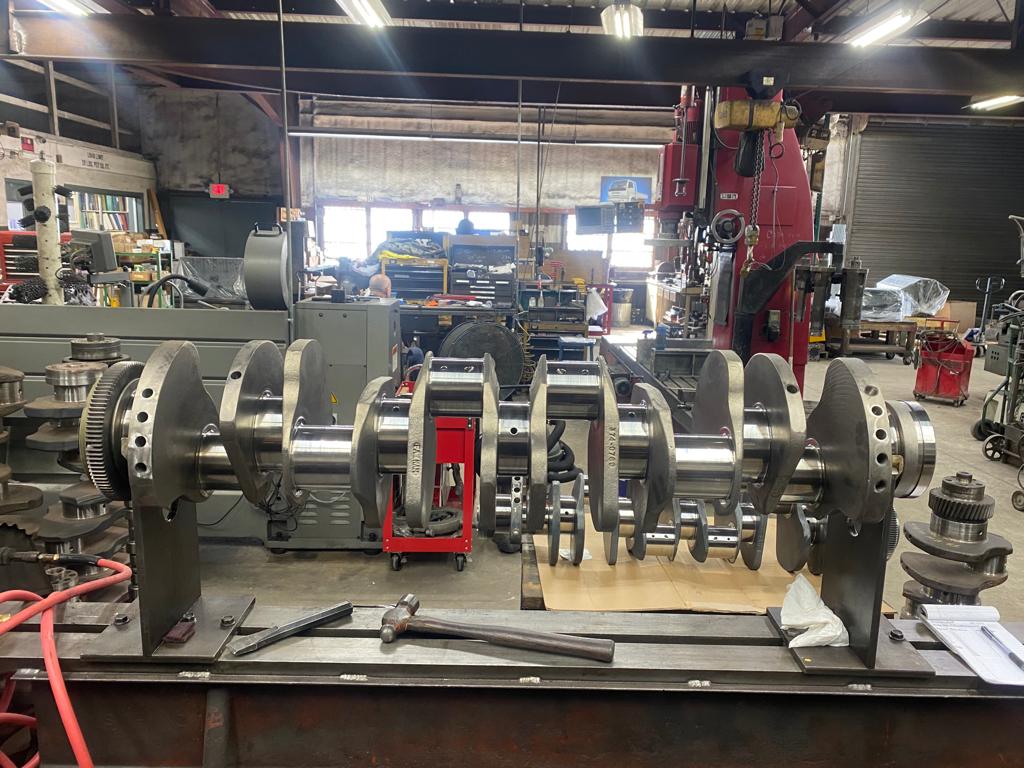
Motor Service Group has provided diesel crankshaft service in Miami since 1949. Every shaft that comes through the shop goes through cleaning, journal measurement, and magnaflux crack detection before any machining work begins. Polishing and precision grinding are performed in-house on equipment built for the tolerances heavy-duty diesel engines require.
The team handles crankshafts from marine engines, fleet trucks, heavy equipment, power generation units, and industrial diesel platforms across Miami-Dade, Broward, and Palm Beach counties.
Crankshaft services include:
- Journal measurement and out-of-round evaluation
- Magnaflux crack detection before any machining
- Precision crankshaft grinding to standard and undersize dimensions
- Journal polishing to OEM surface finish specification
- Post-grind measurement verification before the shaft returns to assembly
Quick Answers
Q: What is the difference between crankshaft grinding and polishing?
Grinding removes material to restore journal geometry and reduce the diameter to an undersize dimension. Polishing improves surface finish without changing diameter. Grinding corrects out-of-round, taper, and deep wear. Polishing addresses light surface imperfections on journals that already measure within specification.
Q: How do I know if a crankshaft needs grinding or replacement?
Journal measurement and magnaflux crack detection determine the answer. If journals measure within a grindable undersize range and no cracks are found, grinding is the appropriate path. If cracks are present, or wear exceeds the last available undersize, replacement is required.
Q: Can a cracked crankshaft be repaired?
Not reliably. Cracks in the fillet radius are a replacement condition. No machining process restores structural integrity to a cracked crankshaft journal. A shaft with fillet cracks should not return to service regardless of how minor the crack appears.
Q: What are undersize bearings and when are they used?
Undersize bearings are manufactured to match crankshaft journals that have been ground to a reduced diameter. Each standard undersize corresponds to a specific bearing set. Confirming undersize bearing availability for the engine application is an essential step before committing to a grind.
Q: Does Motor Service Group perform crankshaft repairs in Miami?
Yes. Motor Service Group performs complete diesel crankshaft service including inspection, magnaflux crack detection, precision grinding, and polishing for engines across South Florida. Contact the team to discuss your crankshaft and get an accurate evaluation before any machining begins.
The Right Call Starts Here
Motor Service Group evaluates every crankshaft before cutting metal.
Contact our expert team today for diesel crankshaft inspection, grinding, and polishing built around the right decision for your engine.