

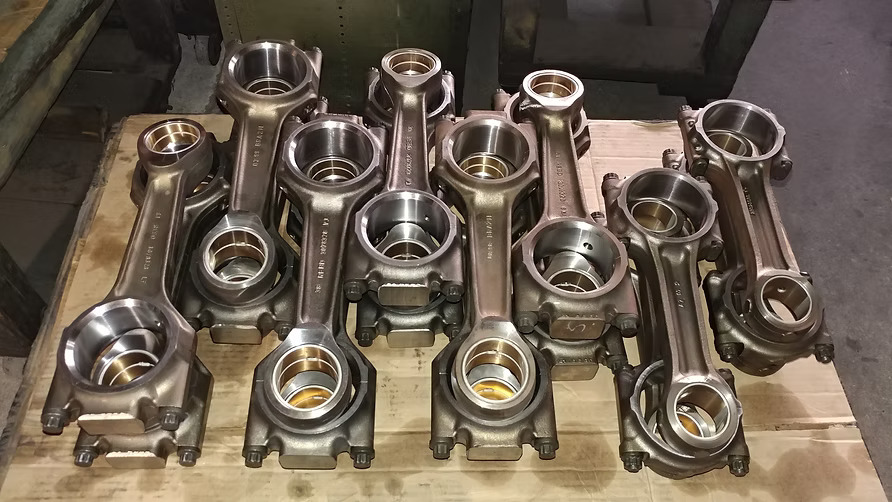
Connecting rods are among the most stressed components in a diesel engine. They transfer combustion force from the piston to the crankshaft on every cycle, under continuous load, heat, and pressure. When a rod is out of spec, the effects travel through the entire lower end of the engine.
This guide covers what connecting rod reconditioning involves, why polishing and bushing replacement are critical steps, and what separates work done correctly from work that causes problems in the next rebuild.
Why Connecting Rod Condition Affects the Entire Engine
What Connecting Rods Do Under Load
Each connecting rod converts the linear force of the piston into the rotational force that drives the crankshaft. The rod must maintain correct geometry, alignment, and bore dimensions throughout its service life to do this without transmitting uneven loads to adjacent components.
How a Rod Out of Spec Damages Surrounding Components
A rod with excessive bend, twist, or bore wear does not distribute load evenly. The results include:
- Accelerated bearing wear at the big end and small end
- Uneven piston pin loading and premature bushing failure
- Side loading on the cylinder wall
- Oil pressure loss from excessive bearing clearance
- Crankshaft journal damage from misaligned rod movement
One rod out of spec puts the entire lower end at risk. Crankshaft damage caused by misaligned rods requires its own assessment. Learn how Motor Service Group handles crankshaft grinding and polishing services.
When Reconditioning Is the Right Call vs Replacement
In heavy-duty diesel applications, connecting rods are expensive to replace and frequently worth reconditioning. A rod that passes magnaflux crack detection and falls within machinable limits can be restored to OEM specification. A rod with structural cracks, severe distortion, or damage beyond machining allowance must be replaced.
The Full Connecting Rod Reconditioning Process
Cleaning and Visual Inspection
Rods are thoroughly cleaned before inspection begins. Carbon deposits, oil residue, and contamination are removed so the technician can assess the actual surface condition of each component. Visual inspection identifies obvious scoring, corrosion, and mechanical damage before more detailed checks are performed.
Magnaflux Crack Detection on Rods and Rod Bolts
Every rod and rod bolt is magnafluxed before reconditioning proceeds. Magnetic particle inspection reveals hairline cracks in the rod body, cap, and bolt seating area that are not visible to the naked eye. Rod bolts operate under extreme tensile stress and develop cracks over time. Any rod or bolt with a crack is removed from the set.
Checking Alignment, Straightness, and Twist
Rods are measured for bend and twist using precision fixtures. Industry standards require no more than .0025 inches of bend and .00425 inches of twist for diesel applications. A rod outside these limits causes oil clearance issues at the pin end and side-loading at the crankshaft thrust face. Rods with correctable misalignment are straightened and re-measured.
Big-End Cap Reconditioning and Bore Sizing
The rod cap parting surfaces are ground to restore the big-end bore dimension. The cap is then torqued to specification and the bore is honed to size. The goal is a round, concentric bore within OEM tolerance that provides the bearing clearance the engine requires.
As little material as possible is removed. Taking too much shifts the rod’s center-to-center length, which must then be corrected separately.
Connecting Rod Polishing and Surface Finishing
After inspection, crack testing, and alignment, the rod shank is polished to remove stress risers, surface irregularities, and machining marks that can become crack initiation points under cyclic load. Polishing also removes sharp edges left from deburring.
This step is not cosmetic. A polished rod resists fatigue cracking under the repeated stress cycles of diesel operation in a way that an unpolished one does not.
Center-to-Center Length Verification
The distance between the big-end bore center and the small-end bore center must match OEM specification across the full set. Rods with mismatched lengths produce uneven compression ratios between cylinders, inconsistent combustion temperatures, and reduced long-term reliability. Length is measured and corrected before the set moves to bushing installation.
Bushing Connecting Rod: What the Small-End Bushing Does and Why It Fails
The Role of the Piston Pin Bushing
The small-end bushing provides the bearing surface between the connecting rod and the piston pin. It must maintain correct inside diameter, wall thickness, and surface finish to support the pin while allowing controlled movement. Without a properly fitted bushing, the piston pin wears the rod bore directly, causing rapid deterioration.
Common Causes of Small-End Bushing Wear and Failure
Bushing wear accelerates when:
- Lubrication to the small end is insufficient or contaminated
- The bushing spins in the rod bore due to improper installation
- Operating temperatures exceed design limits
- Piston pin clearance is incorrect at installation
- The bushing material is mismatched to the application
A spun bushing damages the small-end bore and often requires additional machining before a replacement can be installed.
Why Bushing Replacement Requires Precision
Pressing a new bushing into the rod is not the final step. The bushing must be expanded to conform to the housing bore to prevent spinning. The inside diameter is then machined to achieve the piston pin clearance specified by the engine manufacturer. A bushing installed without these steps will not hold.
How Bushing Replacement Is Performed
Removing the Worn Bushing
The worn bushing is pressed out using appropriate tooling to avoid distorting the small-end bore. If the bushing has spun and damaged the housing bore, that bore is assessed and repaired before a new bushing is installed.
Installing and Sizing the New Bushing
The new bushing is pressed in and expanded to lock it against the housing. The inside diameter is bored to near-final size and finish-honed to the exact piston pin clearance the manufacturer specifies.
Final Pin Fit Verification and Alignment Check
The piston pin is installed and checked for fit and smooth movement. The rod is then re-checked to confirm the pin bore and big-end bore are parallel and the center-to-center length remains within specification before the rod is cleared for reassembly.
Rod Bolt Inspection and Replacement
Why Rod Bolts Are Measured for Stretch
Rod bolts stretch under operating clamp loads. A bolt past its stretch limit cannot generate the torque required to hold the cap correctly, which leads to cap movement, bearing fretting, and rod failure. Each bolt is measured during reconditioning and replaced if it exceeds specification.
When Rod Bolts Must Be Replaced
Replace rod bolts when:
- Stretch measurement exceeds the manufacturer’s limit
- Thread damage or corrosion is present
- The engine has accumulated high service hours
- Any crack is detected during magnaflux inspection
In most heavy-duty diesel rebuilds, replacing the full set of rod bolts is standard practice.
How Motor Service Group Handles Connecting Rod Reconditioning in Miami
Motor Service Group performs connecting rod reconditioning for marine, fleet, heavy equipment, and industrial diesel engines across Miami-Dade, Broward, and Palm Beach counties.
Every rod set is cleaned, crack-tested, aligned, polished, fitted with new bushings, and verified to OEM specification before it leaves the shop. Rod bolts are measured and replaced where required. The full set is treated as a unit, not as individual components, because uniformity across the set is what the engine depends on.
Connecting rod reconditioning is one part of a complete diesel engine rebuild. For a full breakdown of what the reparation process involves from disassembly to final inspection, read our guide on diesel motor reparation and why precision matters.
Quick Answers
Q: What is connecting rod polishing and why is it done?
Polishing removes stress risers, surface irregularities, and sharp edges from the rod shank after machining. It improves fatigue resistance and reduces the risk of crack formation under the repeated load cycles of diesel operation.
Q: When should a connecting rod bushing be replaced?
When the small-end bore shows wear beyond tolerance, the bushing has spun in the housing, or pin clearance cannot be restored by honing alone. In most diesel rebuilds, bushing replacement is standard practice during reconditioning.
Q: Can a bent or cracked connecting rod be reconditioned?
A rod with correctable bend or twist can be straightened if it passes crack detection and falls within machinable limits. A rod with structural cracks or damage beyond those limits must be replaced.
Q: Why does center-to-center length matter in rod reconditioning?
It directly affects compression ratio and combustion consistency across all cylinders. Mismatched lengths in the same set produce uneven combustion, accelerated wear, and reduced reliability.
Q: Where can I get connecting rod reconditioning in Miami?
Motor Service Group provides full connecting rod reconditioning in Miami, including polishing, bushing replacement, alignment, and crack detection for marine, fleet, and heavy equipment diesel engines.
Precision Rod Work, Done Right
Motor Service Group is a diesel engine machine shop in Miami specializing in connecting rod reconditioning, polishing, and bushing replacement for heavy-duty diesel engines.
If your rods require inspection or reconditioning, contact Motor Service Group today.