

Inside a heavy-duty diesel engine, connecting rod bearings support enormous mechanical loads through remarkably small running clearances. Their ability to withstand these forces depends on accurate component dimensions, controlled lubrication and proper assembly.
When a bearing fails, replacing it may seem like the obvious solution. However, the damaged bearing is often evidence of a deeper mechanical problem rather than the original cause of failure.
A worn crankshaft journal, distorted connecting rod housing or contaminated lubrication system can cause a replacement bearing to deteriorate prematurely.
For fleet operators, marine engine rebuilders and industrial maintenance teams, understanding rod bearing failure is essential to developing a repair strategy that addresses the underlying problem rather than temporarily restoring engine operation.
What is rod bearing failure?
Rod bearing failure occurs when the bearing positioned between a connecting rod and its crankshaft journal loses its ability to support normal engine loads while maintaining effective lubrication.
Connecting rod bearings typically use replaceable bearing shells that provide a controlled running surface around the crankshaft journal. During operation, an oil film separates the moving surfaces and distributes mechanical loads.
When that separation becomes inadequate, friction, heat and abnormal contact can progressively damage the bearing.
Depending on the failure mechanism, the bearing may experience scoring, fatigue, material loss, deformation or complete seizure.
What is the difference between a worn bearing and a spun bearing?
Although both conditions involve bearing deterioration, they describe different mechanical problems.
A worn bearing has lost some of its original surface material or operating characteristics but may remain correctly seated within its housing.
A spun bearing occurs when a bearing shell rotates or shifts within the housing where it should remain stationary. Severe friction, inadequate bearing crush, housing distortion or other conditions may contribute to this movement.
| Bearing condition | Typical characteristic | Potential consequence |
|---|---|---|
| Worn bearing | Progressive surface deterioration | Excessive running clearance |
| Scored bearing | Scratches or grooves | Reduced surface integrity |
| Fatigued bearing | Cracking or flaking | Progressive material loss |
| Spun bearing | Shell displacement or rotation | Housing and journal damage |
| Seized bearing | Severe adhesion or mechanical binding | Restricted crankshaft movement |
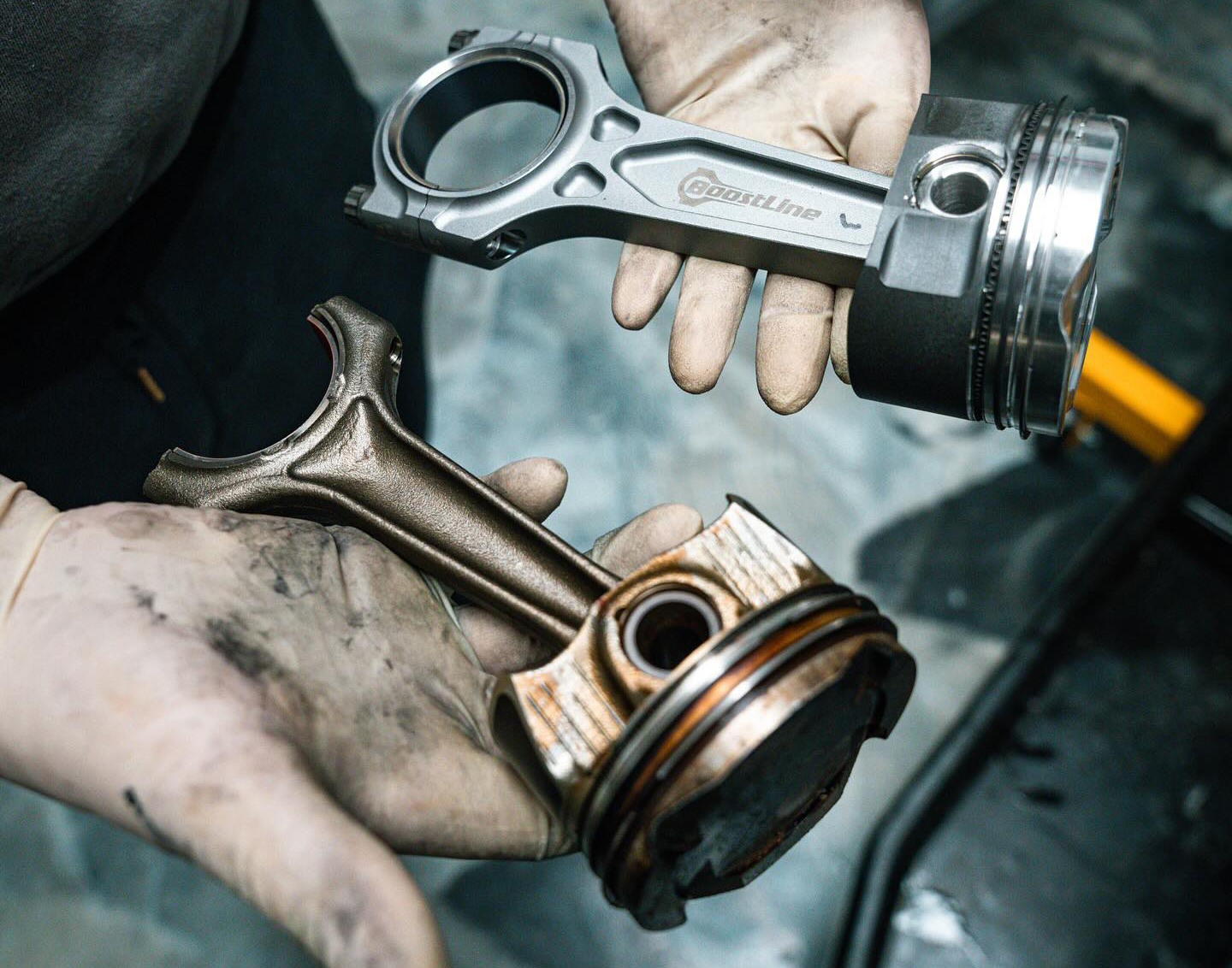
A spun rod bearing can damage the connecting rod’s big-end housing as well as the crankshaft journal, making a simple bearing replacement inadequate.
What causes rod bearing failure in diesel engines?
Several factors can contribute to premature bearing damage. Understanding how each affects the bearing’s operating environment helps technicians identify the correct repair.
Insufficient lubrication
Connecting rod bearings require an adequate oil supply to maintain a protective film between their surfaces and the crankshaft.
Low oil levels, restricted oil passages, pump deterioration and certain pressure regulation faults can interrupt lubrication.
Once the oil film becomes inadequate, localized friction and temperature may increase rapidly. Severe conditions can lead to bearing material transfer and crankshaft journal damage.
Incorrect bearing clearance
Every engine has specific bearing clearance requirements established by its manufacturer.
Insufficient clearance may interfere with lubrication and thermal expansion, while excessive clearance can affect oil pressure, load distribution and component movement.
Incorrect bearing selection or machining dimensions can therefore cause engine bearing failure even when new components have been installed.
Contaminated engine oil
Metallic particles, dirt, coolant and fuel contamination can undermine bearing performance.
Solid contaminants may create abrasive grooves, while fuel dilution can reduce lubricant viscosity. Coolant contamination introduces additional risks involving lubricant degradation and corrosion.
Our article on oil in diesel engine coolant explains how internal leakage between engine systems can create broader reliability concerns.
Crankshaft journal geometry problems
A crankshaft journal must satisfy several requirements beyond its nominal diameter. Surface finish, taper, roundness and alignment all influence how bearing loads are distributed.
A journal may appear smooth while still exceeding permissible dimensional limits.
This is why crankshaft inspection should rely on calibrated measuring equipment rather than visual judgment alone.
Connecting rod housing distortion
The connecting rod’s big-end housing helps maintain correct bearing positioning and geometry.
Overheating, previous mechanical failures and assembly-related problems may alter its shape. A distorted housing can interfere with proper bearing retention and create uneven operating loads.
Installing replacement bearings without evaluating the housing may allow the same failure mechanism to continue.
Rod bearing wear chart: What damage patterns reveal
One of the most valuable diagnostic tools during an engine teardown is the physical condition of the removed bearings.
A rod bearing wear chart helps technicians connect visible deterioration with possible underlying mechanical problems.
| Bearing wear pattern | Possible cause | Recommended inspection |
|---|---|---|
| Long abrasive scratches | Contaminated oil or trapped debris | Oil passages, filtration and journal surface |
| Smeared bearing material | Lubrication breakdown or overheating | Oil supply and journal condition |
| Wear concentrated near one edge | Misalignment or incorrect journal geometry | Rod alignment and journal dimensions |
| Cracks and surface flaking | Fatigue or excessive cyclic loading | Bearing loads and component condition |
| Dark discoloration | Elevated operating temperatures | Lubrication and heat-related deterioration |
| Distorted or displaced shell | Loss of bearing retention or seizure | Connecting rod housing and crankshaft |
| Localized wear near shell joints | Housing distortion or assembly issues | Big-end bore geometry and assembly specifications |
These patterns are diagnostic clues rather than definitive proof of a particular failure mechanism. Multiple problems may produce similar damage, and several mechanisms can occur simultaneously.
Preserving the removed bearings in their original positions helps technicians compare damage across the engine.
What are the symptoms of a spun bearing?
Spun bearing symptoms depend on the severity of the failure and the engine’s operating conditions.
Possible indicators include declining oil pressure, metallic debris in the lubricant, abnormal lower-engine noise and unexpected changes in operating temperature.
In more advanced cases, the engine may lose power or become mechanically restricted.
Although knocking sounds are frequently associated with bearing damage, not every unusual engine noise originates from the connecting rod assembly. Our guide to rod knock in diesel engines explains how this symptom relates to internal mechanical deterioration.
Equipment with suspected bearing failure should remain out of service until the underlying condition is established.
How rod bearing failure damages the crankshaft
The crankshaft journal operates directly alongside the bearing’s lubricated surface. When the bearing deteriorates, the journal can become exposed to abnormal friction and mechanical loading.
This may create scoring, material transfer, excessive wear or changes in journal geometry.
Severe overheating can also affect the journal’s material properties. Depending on the crankshaft design and manufacturing process, heat-related deterioration may limit the available repair options.
Professional crankshaft grinding and polishing services can restore eligible journals when their structural condition and remaining machining allowance permit restoration.
The goal is not simply to remove visible damage. The finished journal must satisfy the manufacturer’s dimensional, surface finish and repair requirements.
How machine shops diagnose engine bearing failure
A comprehensive bearing failure investigation considers the entire mechanical environment in which the bearing operated.
Technicians measure crankshaft journal diameter, taper and out-of-round conditions. Connecting rod big-end bores are checked for geometry and dimensional accuracy under the appropriate assembly conditions.
Suitable nondestructive inspection methods may also be required to identify structural discontinuities in affected components.
The engine block’s main bearing alignment should be evaluated where the failure history suggests broader rotating assembly problems. Lubrication passages, oil coolers and associated components may need inspection to identify retained contamination.
Our resource on cylinder head, block and connecting rod machining explains why these components should be considered as an interconnected mechanical system.
Find the cause before installing new bearings
Replacing damaged bearing shells without inspecting the crankshaft and connecting rods can result in another expensive failure. Motor Service Group provides precision measurements, component inspection and machining support to help rebuilders establish the correct restoration scope.
Can a crankshaft be repaired after rod bearing failure?
Yes, many crankshafts remain repairable after bearing damage. The appropriate restoration method depends on measurable wear, structural condition and manufacturer-approved repair allowances.
Crankshaft polishing
Polishing may be appropriate when surface imperfections are limited and the journal remains within acceptable dimensional and structural limits.
However, polishing cannot correct significant taper, out-of-round conditions or deep journal damage.
Crankshaft grinding
Grinding can restore certain damaged journals to an approved undersize dimension, provided suitable replacement bearings are available and the manufacturer permits the repair.
The process requires accurate control of journal geometry, surface finish and critical features such as fillet radii.
Crankshaft replacement
Replacement may be necessary when inspection reveals unacceptable cracking, severe heat damage or wear beyond permitted machining limits.
A crankshaft that cannot satisfy the engine manufacturer’s repair specifications should not be reused solely to reduce the initial rebuilding cost.
For more information about specialized machining options, explore our guide to crankshaft grinding and repair shops in Florida.
How to prevent repeat rod bearing failure
Reliable bearing performance begins with correct engine preparation and assembly.
All lubrication passages and affected components should be cleaned according to approved procedures, particularly after a failure that has released metallic debris.
Bearing clearances, connecting rod dimensions, crankshaft geometry and fastener tightening requirements must be verified against engine-specific specifications.
The original lubrication problem should also be corrected before the engine returns to service.
Preventive maintenance programs can benefit from oil condition monitoring, manufacturer-recommended service intervals and investigation of abnormal oil pressure trends.
Our guide to diesel motor repair timelines provides further context on why careful inspection and machining are important stages of the rebuilding process.
Restore bearing reliability through precision machining
Rod bearing failure is rarely a problem that should be evaluated in isolation. The bearing, connecting rod, crankshaft and lubrication system all contribute to the operating conditions responsible for its performance.
At Motor Service Group, we support marine engine rebuilders, fleet maintenance teams and industrial equipment operators with specialized diesel engine component inspection and precision machining.
With experience dating back to 1949, our Miami facility helps customers determine which damaged components are suitable for restoration and which require replacement.
Call (305) 592-2440 to discuss your crankshaft or engine component machining requirements.
Frequently asked questions
1. What is the main cause of rod bearing failure?
Rod bearing failure commonly results from inadequate lubrication, contamination, incorrect clearances or component geometry problems. The primary cause varies between engines. Inspection of the bearings, crankshaft journals, connecting rods and oil supply system is necessary to identify the actual failure mechanism.
2. Can you fix a spun rod bearing without replacing the engine?
Yes, in some cases. Repair may involve crankshaft restoration, connecting rod replacement or approved reconditioning, new bearings and lubrication system restoration. Complete engine replacement becomes a consideration when structural damage or repair costs make rebuilding impractical.
3. Does a spun bearing always damage the crankshaft?
Not necessarily, but crankshaft damage is a significant possibility. A displaced bearing shell can interfere with lubrication and create abnormal friction against the journal. Accurate dimensional measurements and structural inspection are required to determine whether the crankshaft remains repairable.
4. Can you replace rod bearings without machining the crankshaft?
Bearing replacement without crankshaft machining may be appropriate when the journals remain within the manufacturer’s dimensional, structural and surface finish specifications. The connecting rod housings and original failure cause must also be evaluated before the new bearings are installed.
5. How long can an engine run with a bad rod bearing?
There is no reliable operating period that can be considered safe. Bearing deterioration can progress rapidly and cause additional crankshaft, connecting rod or engine block damage. An engine with suspected bearing failure should be removed from service for professional diagnosis.
6. Can low oil pressure cause rod bearing failure?
Yes. Inadequate oil supply can prevent the formation of an effective lubricating film, increasing friction and bearing temperature. However, low oil pressure may also result from existing bearing wear, so determining whether it is a cause or consequence requires further investigation.