

The camshaft rarely gets attention on its own. It shows up as a line item inside a crankshaft job, a mention inside a full rebuild, or a quick inspection tacked onto other work. That’s a mistake. The camshaft controls valve timing for every cylinder in the engine, and worn lobes or journals can undo the benefit of everything else that gets repaired around it, even a freshly ground crankshaft or a rebuilt cylinder head.
This guide covers what camshaft wear actually looks like, when grinding is necessary versus when polishing is enough, and why inspection before reassembly matters as much as the machining itself.
Why the Camshaft Gets Overlooked Until It Fails
The Camshaft’s Role in Valve Timing and Engine Performance
The camshaft opens and closes intake and exhaust valves in precise sync with the crankshaft. That timing determines how much air each cylinder receives and when exhaust gets expelled. A camshaft that has lost its original lobe profile changes that timing, even if every other component in the machine is in perfect condition. Under heavy load, that small shift in valve timing translates directly into lost power, higher fuel consumption, and rougher running that often gets blamed on other components first.
Why Camshaft Condition Often Only Gets Checked as Part of Other Work
Most camshaft inspection happens as a side effect of teardown for something else, a crankshaft job, a full rebuild, or a failure diagnosis. That approach catches obvious damage, but it can miss gradual deterioration that hasn’t yet caused a symptom. A camshaft that looks fine at a glance can still be measurably out of spec, since lobe condition declines slowly over thousands of hours and often doesn’t produce a noticeable symptom until it has already progressed well past the point where a simple polish would have corrected it.
What Camshaft Wear Actually Looks Like
Camshaft damage shows up in a few distinct ways, and each one points to a different repair path:
- Flattened noses, pitting, scoring, or metal flaking on the lobe’s contact surface
- Journal wear, where the bearing surfaces have worn out of round or below tolerance
- Bent or warped shafts, usually from heat exposure or a prior mechanical failure elsewhere in the engine
A camshaft can show one of these problems in isolation or several at once. Isolated damage on a single cylinder’s lobe often points to a localized issue, like a sticking lifter or a follower that stopped rotating properly during operation. Damage spread evenly across every lobe usually points to a lubrication problem instead, low oil pressure, contaminated oil, or extended intervals between oil changes that let abrasive particles circulate through the valvetrain over time.
When Grinding Is the Right Call
Measuring Lobe Lift and Duration Against OEM Spec
Grinding decisions start with measurement, not visual inspection. Lift and duration get checked against the original equipment manufacturer’s specification for that camshaft, using precision measuring tools rather than a visual comparison. If the profile has worn enough to fall outside that spec, grinding is what restores it, not polishing, since polishing only affects surface finish and cannot correct a contact surface that has actually lost material and height.
Journal Grinding to the Next Undersize
When journals have worn out of round or scored beyond what polishing can correct, grinding to the next standard undersize restores a true, round surface. This step requires a matching undersize bearing set on reassembly, the same logic that applies to crankshaft journal work, and skipping that match creates incorrect clearance that shortens bearing life regardless of how well the grinding itself was done.
Straightening a Bent or Warped Camshaft
A camshaft that has bent from heat or a related engine failure needs straightening before any lobe or journal work makes sense. Running a bent shaft, even after grinding, leaves it rotating untrue inside the engine, which accelerates wear on everything it touches, including the very bearings and lifters that were just replaced during the rebuild.
Camshaft Polishing Diesel Engine
Minor Surface Wear That Doesn’t Require Material Removal
Not every camshaft needs grinding. When lift and journal dimensions are still within OEM tolerance, but the surface shows light scoring or roughness, polishing corrects that finish without removing material the shaft doesn’t need to lose. This is a meaningfully different repair than grinding, both in cost and in what it actually accomplishes.
Why Polishing Reduces Friction and Protects New Bearings and Lifters
A polished surface reduces friction against lifters, followers, and bearings, which matters most right after a rebuild, when new components are breaking in against the camshaft for the first time. Skipping this step on a shaft with rough surface texture accelerates wear on every new part installed alongside it, which can turn what should have been a straightforward polish into a repeat failure a few thousand hours later.
How to Tell If a Camshaft Only Needs Polishing, Not Grinding
The distinction comes down to measurement, not appearance. A shaft with dimensions still inside spec and only surface-level roughness is a polishing candidate. Once lift has dropped below spec or journals have scored past a light surface issue, polishing alone won’t fix what’s actually wrong, and treating a grinding-level problem as a polishing job just delays the real repair.
Camshaft Inspection Before Reassembly
Matching a Camshaft to the Exact Engine Model and Application
A camshaft has to match the exact engine model, and often the specific variant, to function correctly. Casting marks, part numbers, and application details all matter here. A camshaft that looks similar to the original but doesn’t match the exact specification can throw off valve timing even when it physically fits without issue.
What Happens When a Worn Camshaft Goes Back Into Service Unchecked
A worn camshaft that goes back into service without inspection doesn’t fail immediately. It fails gradually, through reduced power, rough idle, and accelerated wear on the lifters and bearings around it. By the time symptoms are obvious, the damage has usually spread beyond the camshaft itself, which turns a contained repair into a larger one involving components that were otherwise in good condition.
How the Shop Handles This Work In-House
Precision Measuring and Grinding Equipment Used On-Site
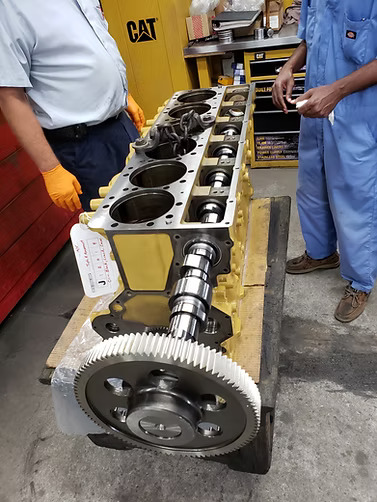
Camshaft grinding, polishing, and straightening all require dedicated measuring and machining equipment, not general-purpose tools. Motor Service Group performs this work on-site in Miami, using precision measuring tools to check lift, journal dimensions, and straightness before any grinding decision gets made, so the repair matches what the camshaft actually needs rather than a guess made from a visual check.
Why In-House Camshaft Work Avoids the Delays of Outsourcing
A shop that sends camshaft grinding to a subcontractor adds shipping time and a second point of handling to the job. Keeping this work in-house means a camshaft moves from inspection to machining without leaving the building, which shortens turnaround on a job that’s often already holding up a larger rebuild for a fleet, marine, or heavy equipment customer who needs it back in service.
Quick Answers
Does a camshaft need to be replaced if it’s worn, or can it be repaired?
Many worn camshafts can be repaired through grinding or polishing, depending on how far the wear has progressed. Camshafts with severe lobe damage, deep pitting, or structural cracking typically need replacement instead.
What’s the difference between camshaft grinding and camshaft polishing?
Grinding removes material to restore lobe profile or journal roundness when wear has moved outside OEM spec. Polishing improves surface finish on a camshaft that’s still within spec, without removing material.
How do I know if my camshaft needs inspection?
Any engine coming apart for other work is a reasonable opportunity to inspect the camshaft, even without obvious symptoms. Rough idle, reduced power, or valvetrain noise are signs worth investigating directly.
Can a camshaft be reused after grinding without new bearings?
No. Grinding journals to an undersize requires a matching undersize bearing set. Reusing standard bearings on a ground journal creates incorrect clearance.
Does Motor Service Group perform camshaft grinding and polishing in Miami?
Yes. Motor Service Group performs camshaft grinding, polishing, and straightening in-house using precision measuring equipment, alongside crankshaft, cylinder head, and Magnaflux crack detection services.
Get Your Camshaft Checked Before Reassembly
Motor Service Group performs camshaft grinding, polishing, and inspection in-house in Miami, backed by precision measuring equipment and over 75 years of diesel machining experience.
Contact our team today to get your camshaft inspected before it goes back into service.