

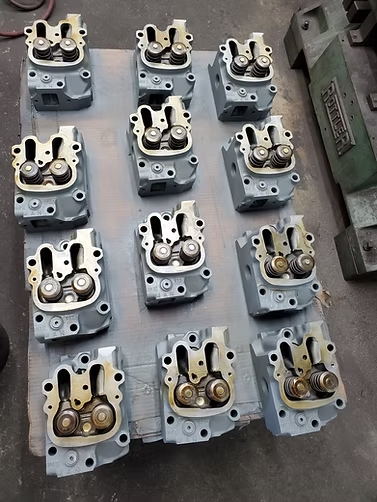
In heavy-duty diesel and industrial engines, reliability is not luck. It is the result of inspection, precision machining, and controlled tolerances applied to the components that carry load and heat every second the engine runs.
Three components determine whether an engine survives continuous-duty operation:
- Cylinder head: controls combustion sealing, airflow, and valve integrity
- Engine block: provides the structural foundation and alignment for rotating assemblies
- Connecting rods: transfer power under extreme compression and tensile loads
When any of these components drift out of specification, the results are predictable: loss of compression, overheating, bearing failure, vibration, oil or coolant contamination, and in worst cases catastrophic damage and extended downtime.
This guide explains how cylinder head machining, engine block machining, and connecting rod service work together to restore reliability, stop repeat failures, and protect engine life in fleet, marine, power generation, and heavy industrial applications.
Why These Components Fail and Why Precision Machining Matters
Even minor dimensional issues can cause major outcomes in continuous-duty engines. The most common symptoms include:
- Compression loss and hard starts
- Oil or coolant leaks
- Premature bearing wear
- Overheating and thermal stress
- Reduced power and efficiency
- Imbalance and vibration
The reason is simple: engines are systems built on geometry. When sealing surfaces, bore alignment, or rotating clearances are not correct, new parts are forced to operate under uneven loads.
Precision machining restores surfaces and alignment back to specification, so new or reused internal components operate correctly and predictably.
Cylinder Head Machining: Restoring Sealing, Combustion, and Airflow
Cylinder heads experience extreme thermal cycling. Overheating, detonation, and fatigue can cause:
- Warping that breaks head gasket sealing
- Valve seat damage that reduces compression
- Cracks, visible or microscopic
- Cooling passage leaks that contaminate oil
- Combustion instability due to poor valve geometry
A professional cylinder head machining process focuses on restoring:
- Deck flatness for correct sealing
- Valve seat geometry for consistent compression
- Guide condition to prevent oil consumption
- Combustion chamber consistency to stabilize performance
- Airflow performance through ports when applicable
If cylinder heads are reused without machining and verification, gasket failures and repeat overheating patterns often return quickly.
Magnaflux Crack Detection and Pressure Testing
Not all damage is visible. That is why Magnaflux crack detection and pressure testing should be treated as non-negotiable steps.
Magnaflux crack detection
Magnaflux testing identifies microscopic cracks in ferrous components using magnetic inspection methods. It is especially important after overheating or mechanical shock.
Pressure testing
Pressure testing validates integrity under controlled pressure to identify leaks, weak points, or internal crack paths that do not show externally.
These inspections prevent wasted machining time on heads that cannot be repaired reliably and reduce the risk of reinstalling a component that will fail again under load.
Engine Block Machining: The Foundation of the Engine
If the engine block is distorted or worn, everything riding inside it suffers. Professional engine block machining addresses common failure drivers such as:
- Cylinder bore wear and taper
- Deck surface warping
- Main bore alignment issues
- Sealing surface damage and corrosion
- Evidence of bearing movement or crank misalignment
Common block machining operations
A precision engine block machining workflow commonly includes:
- Boring and honing to restore bore geometry and surface finish
- Decking to restore flatness for head gasket sealing
- Align boring (or align honing) to correct main bore alignment for bearing life and crank stability
- Sleeving when bores are beyond safe limits
If block geometry is off, even brand-new internals can fail early because load distribution and oil film stability depend on correct alignment.
Connecting Rod Service: Strength, Balance, and Bearing Protection
Connecting rods operate under extreme stress cycles. Small dimensional inconsistencies can cause:
- Imbalance and vibration
- Uneven bearing wear
- Oil clearance problems
- Rod twist or bend that changes piston motion
- High risk of rod or bearing failure under heavy load
A professional connecting rod service typically includes:
- Dimensional inspection
- Bushing replacement and sizing
- Big-end and small-end resizing
- Straightness and twist correction
The outcome is correct bearing clearances and stable engine balance, especially important for engines running continuously under high torque.
Crankshaft and Camshaft Machining: Completing the System
While heads, blocks, and rods form the core, crank and cam work often determines whether the rebuild lasts.
- Crankshaft grinding and polishing restores journal surfaces and supports oil film stability.
- Camshaft machining supports accurate valve timing and consistent performance.
These services are often performed together because engine reliability depends on the full geometry chain, not one corrected component surrounded by uncontrolled tolerances.
Machining vs Replace: How to Decide the Correct Repair Strategy
Machining is often the best path when:
- Replacement lead times are long
- Downtime must be minimized
- The core casting is serviceable
- You need near-OEM geometry without full replacement cost
Replacement may be smarter when:
- Cracks compromise structural integrity
- Pressure testing fails
- Machining would exceed safe tolerances
- The component cannot be reliably restored
A professional inspection tells you which path is safest and most cost-effective, based on measured condition instead of assumptions.
Quality Control: What a Professional Machine Shop Verifies
A specialized diesel or industrial machine shop reduces risk by verifying, not guessing. Key quality checks typically include:
- Flatness and surface finish verification
- Bore geometry measurements (roundness, taper)
- Main bore alignment checks
- Rod big-end and small-end sizing validation
- Crack detection and pressure testing records where applicable
Without strict QC, “repairs” can introduce misalignment, improper clearances, and early failure even when the engine appears to run well during initial startup.
A Practical Checklist Before You Approve a Rebuild
Use this checklist to reduce the chance of repeat failures:
- Cylinder head has been pressure tested and crack checked
- Deck surfaces are measured and corrected if required
- Valve seats and guides are inspected and machined to spec
- Block bores are corrected (bored, honed, or sleeved) as needed
- Main bore alignment is verified and corrected when out of spec
- Rods are inspected, resized, and corrected for straightness
- Crank and cam surfaces are inspected and restored where required
This is the difference between an engine that returns to work and one that returns with the same problems.
Frequently Asked Questions
Q. How do I know if a cylinder head needs machining?
Common indicators include overheating history, compression loss, coolant consumption, repeat gasket failures, or visible warping and seat damage. A shop should confirm with measurement, crack detection, and pressure testing.
Q. When is align boring necessary on an engine block?
Align boring is often required after bearing failures, overheating distortion, or evidence of main bore movement. Misalignment reduces oil film thickness and accelerates bearing damage.
Q. Do connecting rods really need machining if they look fine?
Yes. Rod issues are often dimensional, not visual. Small changes in bore size or alignment can drive bearing wear, vibration, and unstable oil clearance.
How Motor Service Group Supports Engine Reliability
Motor Service Group provides precision machining services including:
- Cylinder head machining
- Engine block machining
- Connecting rod service
- Magnaflux crack detection
- Pressure testing
- Crankshaft and camshaft machining
If your engine components show wear, overheating damage, leaks, or performance loss, contact our team. Our machining specialists can inspect your cylinder heads, blocks, and connecting rods, then recommend the right repair strategy to restore performance and reliability.